Trademark Monitoring API | Automate Trademark Tracking & Alerts
June 18, 2026
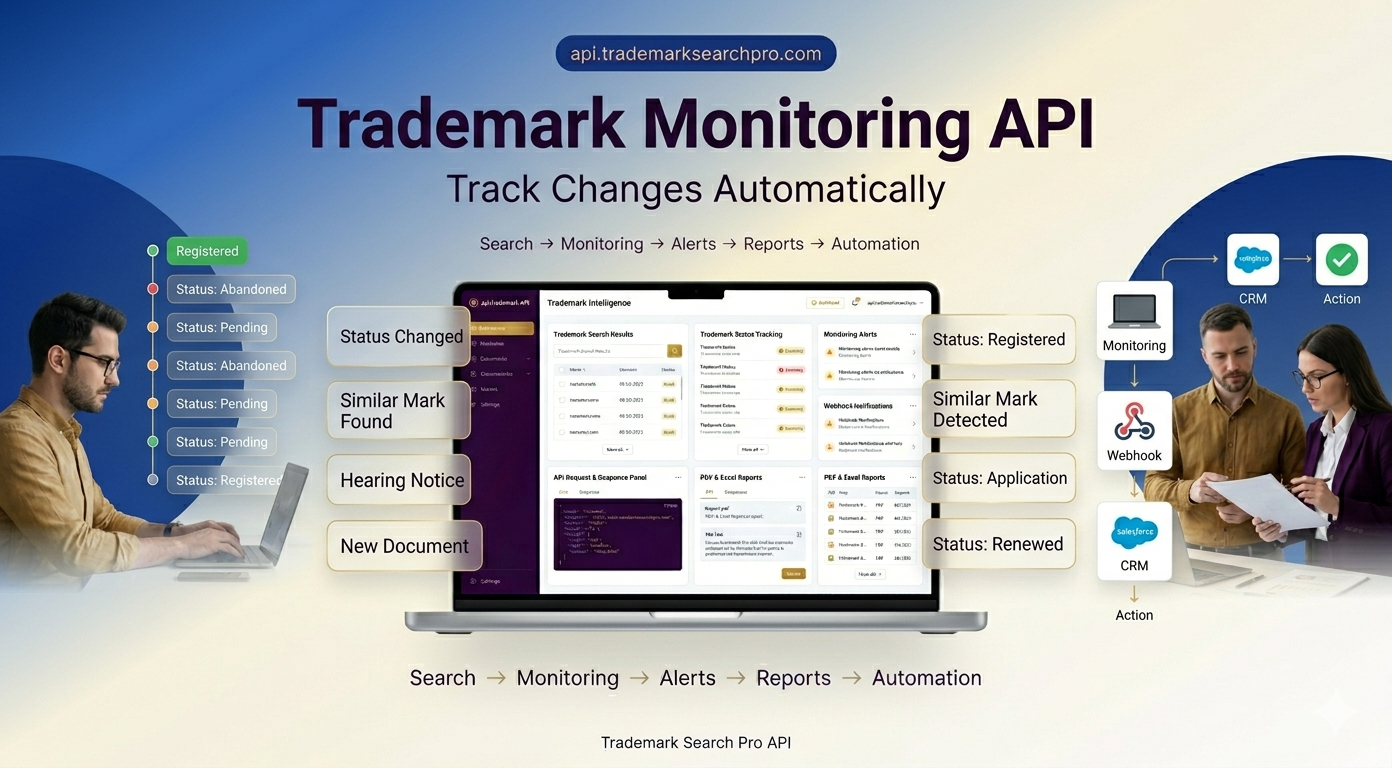
Trademark Monitoring API: How to Automatically Track Status Changes, Similar Marks, and Trademark Risks
Protecting a trademark does not end after filing an application. In reality, filing a trademark is only the beginning of the trademark lifecycle.
Every day, trademarks move through different stages. New examination reports are issued, status changes occur, hearing notices are uploaded, oppositions are filed, and new trademark applications enter the system. Businesses that fail to monitor these developments risk missing important deadlines, losing legal rights, or facing unexpected brand conflicts.
Traditionally, organizations have relied on manual monitoring. Team members regularly search trademark records, download documents, review journal publications, and update spreadsheets. While this may work for a small number of trademarks, it becomes inefficient and expensive as portfolios grow.
This is where a Trademark Monitoring API becomes essential.
A Trademark Monitoring API allows businesses to automatically track trademark activity, receive alerts, monitor risks, and stay informed about important developments without manually checking records every day.
In this article, we will explore how trademark monitoring APIs work, why businesses need them, and how organizations can automate trademark protection using modern API technology.
What Is a Trademark Monitoring API?
A Trademark Monitoring API is a system that continuously tracks trademark-related activities and notifies users whenever important changes occur.
Unlike a standard Trademark Search API, which provides information only when a search is performed, a monitoring API actively watches trademarks and generates alerts whenever new events are detected.
A monitoring system can track:
-
Trademark Status Changes
-
Examination Reports
-
Journal Publications
-
Opposition Activity
-
Hearing Notices
-
Trademark Documents
-
Similar Trademark Applications
-
Renewal Deadlines
-
Compliance Deadlines
This allows organizations to move from reactive trademark management to proactive trademark protection.
Why Trademark Monitoring Is More Important Than Trademark Search
Many businesses invest time in trademark searches before filing.
However, very few businesses invest in continuous monitoring after filing.
This creates significant risks.
For example:
A startup files a trademark application and assumes everything is progressing smoothly.
Weeks later:
-
An examination report is issued.
-
A hearing notice is uploaded.
-
A compliance deadline approaches.
If the business does not discover these developments in time, it may lose valuable rights or face unnecessary delays.
A Trademark Monitoring API helps eliminate these risks by continuously tracking relevant events.
Common Trademark Risks Businesses Face
Status Changes
Trademark applications regularly move through different stages.
Examples include:
-
Formalities Check Pass
-
Objected
-
Accepted
-
Advertised
-
Opposed
-
Registered
-
Abandoned
Missing an important status update can delay necessary action.
Examination Reports
Examination reports often require timely responses.
Organizations that fail to monitor examination reports may miss critical deadlines.
Opposition Proceedings
Trademark oppositions can significantly impact brand protection efforts.
Businesses need visibility whenever opposition-related activity occurs.
Similar Trademark Applications
One of the biggest risks to any brand is the filing of similar trademarks.
Monitoring systems can identify potentially conflicting trademarks before they become major problems.
Renewal Deadlines
Many trademark owners lose rights simply because renewal deadlines are missed.
Automated monitoring helps prevent this issue.
Who Should Use a Trademark Monitoring API?
Law Firms
Law firms managing trademark portfolios for multiple clients benefit from automated monitoring.
Instead of manually checking hundreds of records, firms can receive alerts automatically.
Benefits include:
-
Improved client service
-
Reduced manual effort
-
Faster response times
-
Better portfolio management
Startups
Startups often lack dedicated intellectual property teams.
A Trademark Monitoring API helps founders stay informed about:
-
Application progress
-
Similar trademark filings
-
Compliance deadlines
-
Registration updates
Enterprises
Large organizations may manage hundreds or thousands of trademarks.
Monitoring APIs help automate:
-
Risk detection
-
Portfolio monitoring
-
Renewal tracking
-
Compliance management
E-Commerce Marketplaces
Marketplaces can use trademark monitoring to identify potential brand conflicts and improve intellectual property compliance programs.
SaaS Platforms
Legal-tech and compliance platforms can integrate monitoring capabilities directly into their applications.
This creates additional value for users while reducing manual workloads.
Key Features of a Modern Trademark Monitoring API
Status Change Monitoring
The system automatically detects changes such as:
-
Objected
-
Accepted
-
Opposed
-
Registered
-
Abandoned
Users receive notifications whenever changes occur.
Examination Report Monitoring
The API tracks newly available examination reports and alerts users when action may be required.
Journal Monitoring
Journal monitoring helps businesses identify potentially conflicting trademark applications published in trademark journals.
Similar Trademark Monitoring
Organizations can monitor specific brand names and receive alerts whenever similar applications are detected.
This is one of the most valuable brand protection features available today.
Hearing Monitoring
Monitoring hearing notices helps businesses prepare for upcoming proceedings and avoid missed hearings.
Document Monitoring
Users can receive alerts whenever new trademark-related documents become available.
Why Webhooks Are Transforming Trademark Monitoring
Many organizations rely on scheduled API calls to check for updates.
While this works, it can create unnecessary API usage and delays.
Modern monitoring systems increasingly use webhooks.
A webhook allows the monitoring platform to send information directly to a business application whenever an event occurs.
Examples include:
-
Status Changed
-
Examination Report Uploaded
-
Hearing Notice Added
-
Similar Trademark Detected
-
Opposition Filed
Instead of repeatedly checking for updates, businesses receive information instantly.
This creates a more efficient and scalable monitoring architecture.
Real-World Example
Imagine a company managing 500 trademarks.
Without monitoring:
-
Staff manually search records.
-
Documents are downloaded individually.
-
Deadlines are tracked in spreadsheets.
-
Important updates may be missed.
With a Trademark Monitoring API:
-
Status changes are detected automatically.
-
Alerts are generated instantly.
-
Reports are created automatically.
-
Teams receive real-time notifications.
The difference in efficiency can be substantial.
Introducing Trademark Search Pro Monitoring API
Trademark Search Pro provides a comprehensive Trademark Monitoring API designed for businesses, law firms, startups, marketplaces, and SaaS platforms.
The platform supports monitoring across multiple trademark events, including:
-
Trademark Status Changes
-
Examination Reports
-
Journal Publications
-
Similar Trademark Detection
-
Opposition Activity
-
Hearing Notices
-
Document Updates
-
Compliance Events
-
Renewal Events
Organizations can integrate monitoring directly into their systems and receive updates automatically.
Why Businesses Choose Trademark Search Pro API
Unlike basic trademark search solutions, Trademark Search Pro focuses on continuous trademark intelligence.
Key advantages include:
-
50+ API Endpoints
-
Trademark Monitoring API
-
Trademark Search API
-
Bulk Search Capabilities
-
Logo Search API
-
PDF Report Generation
-
Excel Report Generation
-
Real-Time Monitoring
-
Webhook Support
-
Developer-Friendly Integration
This enables businesses to move beyond simple searches and build fully automated trademark workflows.
The Future of Trademark Protection
The future of trademark management is automation.
Organizations increasingly expect software to:
-
Detect risks automatically
-
Monitor trademarks continuously
-
Generate alerts instantly
-
Track compliance deadlines
-
Notify users about important developments
Trademark Monitoring APIs make this possible.
Businesses that adopt automated monitoring gain better visibility, stronger brand protection, and more efficient operations.
Conclusion
Trademark searches are important, but monitoring is where long-term brand protection happens.
Businesses that rely solely on manual tracking often struggle to keep up with status changes, examination reports, opposition proceedings, hearing notices, and similar trademark filings.
A Trademark Monitoring API provides continuous visibility into trademark activity and helps organizations respond quickly when important events occur.
Whether you are a startup, law firm, marketplace, enterprise, or SaaS provider, automated trademark monitoring can significantly improve efficiency and reduce risk.
If you are looking for a comprehensive monitoring solution with real-time alerts, webhooks, reporting capabilities, and more than 50 trademark-related endpoints, explore Trademark Search Pro API today.
API Platform:
api.trademarksearchpro.com
API Documentation:
api.trademarksearchpro.com/docs
.jpeg)
.png)